links

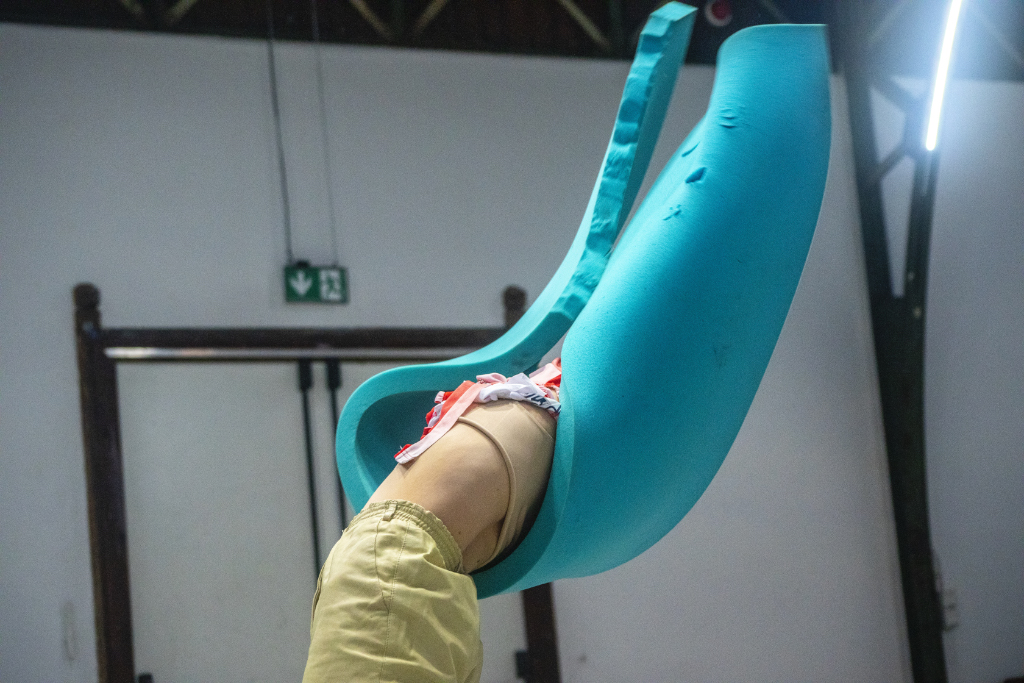
Through a subtle and precarious approach,“An attendee” tries to guide the audience perspective into the details of space, along the edge of (un)spectacular events, towards the frictions of different encounters. Small stimulation open up to bigger questions, emotionally and energetically charged, as a single performer finds themself in the company of a set of things, fragments and sounds. Upon encounter they transform into subjects, into micro narratives and locations, sketching out a place of memory, loss and hope, where leftover voices give their account.
As the performer moves along and with them, a precise, soft and concentrated body emerges that tries to attend to these accounts, encapsulated in the environment. In the attempt of overcoming a present state of affair towards another state of “future”, the performer encounters internalised projections, obsessions, lingering violence and wounds.
The practice that this work brings to the foreground tries to investigate the utility of being in a broken place, that a priori to fixing or saving, asks to be embraced with delicacy and care, with trouble, yet attention. The viewer is invited to join and rest in this space too, without pushing for answers, judgement and absolution, and to give in to the disquiet.
By looking at ecological philosophies and environmental precarity, effectively supported by an isolating pandemic, Toni Steffens is investigating anew what the notions of “environment” can mean within the theatrical and artificial realm of the black box. In her practice she refers to the context of visual arts and balancing on the line between two different traditions of mediation, in between spectacle and installation, theatre and still life/exhibition. Being sensitive to western arts traditions, she imitates the “gallery space” to foreground the power of things, objects and more than human reality. Here is where she uses performance and theatre with a notable emphasis on movement to let those things open up, create mystery and discourse, take the lead of the story and question the human body in their arrangement and encounter.
Booking info:
length: 48 mins
I am travelling together with my light designer Paulina Prokop. The set deisgn and lights fit into two trollis and two odd sized luggages.
Credits
Choreography and Performance: Toni Steffens
Set design: Nikola Knezevic and Toni Steffens
Costume: Ginta Tinte
Lights: Paulina Prokop
Sound: Toni Steffens, Teresa Winter
Advise: Keerthi Basavarajaiah
Notable Attendees influencing the work: Alina Popa, Ana Mendieta, Camille Claudel, Jeanne Dielman
Production: Veem House for Performance, NBprojects, 2020
Reviews:



.jpg)


.png)
.png)


.png)
